
New Dietary Guidelines
History. The US Department of Agriculture (USDA) first published a dietary guideline in 1884 (as a farmer’s bulletin). 1941 marked the first Recommended Dietary Allowance (RDI) listing specific intakes for calories, protein, iron, calcium and some vitamins.
Graphics or lists began in 1943 with the Nutrition Guide promoting 7 basic food groups (in part to match food rationing in WWII). From 1956 to 1992 the USDA described 4 basic food groups. In 1992 the USDA created the food pyramid graphic (with bread rice grains and pasta at the bottom). Between 2011 and 2026 was the “My Plate” graphic with 5 food groups.
1980 marked the first modern “Dietary Guidelines” with revisions every 5 years.
Critique of the New Guidelines.
The theme of the 2025-2030 Dietary Guidelines is to eat whole foods and avoid added sugars refined grains and other highly processed foods.
Good Aspects. I like some aspects of the new guidelines. See my page on “Highly Refined Foods and Fiber”.
Reduce Sugar: The new guidelines suggest: A) no more than 10 grams of added sugar per meal (down from 50g for the day); and B) recommend no added sugar for children under 10 (an increase from age 2). Added sugar increases the glycemic index of any food and provides no other nutrients. It contributes to a variety of health-related problems.
And while some sugars have lower glycemic index (such as fructose) I include ANY form of sugar in this category (disaccharide table sugar, high-fructose corn syrup, honey, molasses or maple syrup). Part of the reason I am concerned with added sugar (compared to the natural sugar, 19 grams, in an apple) is that in plants, dietary fiber largely exists as part of their cell walls. That is much of the sugar is inside the fiber of the cell walls. It is both the fiber itself and the structure of the fiber in fruits and vegetables the lowers the glycemic index of the sugar.
Avoiding Highly Refined Foods. As I mention elsewhere, I believe highly refined food is the worst problem in American nutrition. Ultra refined foods represent about 70% of Americans calories and 90% of the sugar eaten.
Limit Sodium. The recommendation of limiting sodium to 2300 mg/day (in the old guidelines) was retained.
Mixed Implications
A new focus on protein. The new guidelines suggest a range of 1.2 to 1.6 grams of protein per kilogram of body weight. I believe that many Americans do not eat enough protein, and there is evidence that older people need more protein since they don’t synthesize proteins as well as when they were younger. See my page on protein.
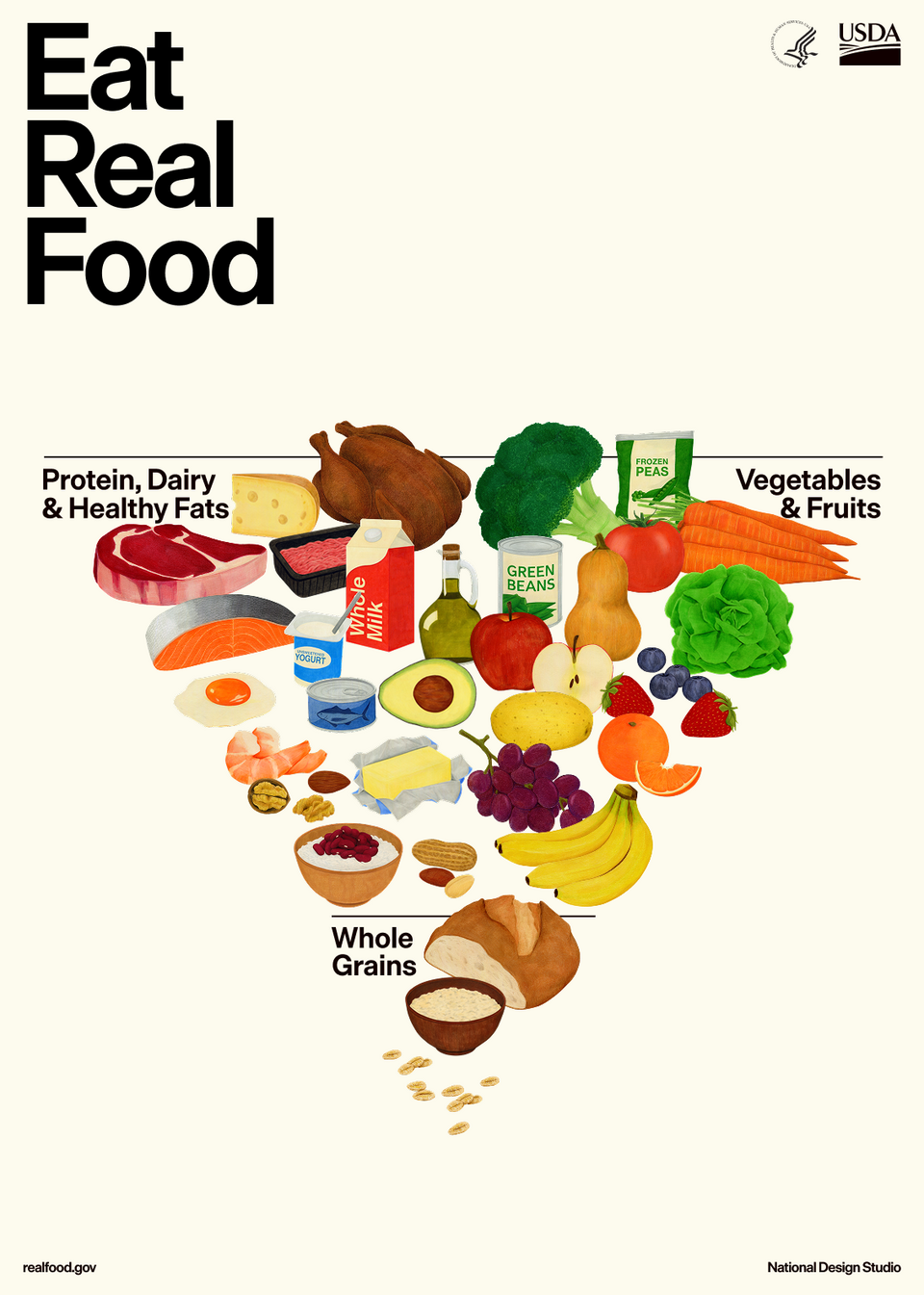
My biggest concern is that there is no mention of the science related to red meat. Consuming high amounts of red meat is associated with increased LDL, dementia, inflammation, cardiovascular disease, cancer, and eye problems. Some lean red meat is certainly fine, but the graphic accentuates red meat.
Max 10% of calories from Saturated Fat. See my page on Fats. This is the old recommendation that is retained – and it is correct. Indeed, the American Heart Associate recommends no more than 6% of calories from fat.
The mixed messages surrounding saturated-fat-rich foods such as red meat, butter, and beef tallow may lead to confusion and potentially higher intake of saturated fat and increased LDL cholesterol and cardiovascular risk. The graphic and the suggestion of 3 dairy servings per day will lead people to overshoot the 10%. If the three dairy servings are full fat in combination with animal protein with any fat – the 10% is exceeded.
In my page on Fats, I have a list of 30 foods with a high amount of saturated fat.
Bad Implications
Good Fats & Bad Fats Above I already noted that the guidelines could lead to violation of the 10% saturated fat standard. And while salmon (Omega-3) and olive oil (Omega-9) appear in the graphic there is no mention of Omega-6 fats. It is well known that RFK jr dislikes seeds oils and Omega-6 fats are most commonly derived from seed oils such as Canola oil (which also contains a high proportion of Omega-3 fatty acids).
However, there is clear evidence that these fats, when displacing saturate fats, reduce mortality from multiple causes. See my page “Fats”
No Transparency in the Process and Divergence from Science Standards.
Leading up to a new dietary guidelines, the Dietary Guidelines Advisory Committee—an independent group of nutrition science experts—summarizes the current state of nutrition science without influence from government or food industry. Members are vetted through extensive background checks, undergo ethics training, and scientific committee meetings are livestreamed.
However, this time around, the Committee’s report was ultimately rejected by the current administration. It was replaced by analysis by a group of hand-picked individuals. “As of today, there has not been transparency in who wrote the new DGAs. … The reviews themselves, as well as their overall presentation and integration, deviate significantly from the rigorous process that the HHS developed for the DGAs to ensure the evidence base and its committees’ conclusions were replicable, unbiased, transparent, and free from non-scientific influences.”Dietary Guidelines for Americans 2025-2030: Progress on added sugar, protein hype, saturated fat contradictions • The Nutrition Source
The hand-picked experts also have ties with the beef and dairy industries. Experts behind new dietary guidelines have ties to beef, dairy industries | STAT
Sources:
Food pyramid (nutrition) - Wikipedia
History of USDA nutrition guidelines - Wikipedia
Protein Requirements and Recommendations for Older People: A Review - PMC
Mayo Clinic Minute: Does eating red meat affect heart health? - Mayo Clinic News Network
RFK Jr. slams seed oils but research links them to lower risk of mortality and cancer